
What?
Huh?
Why is binding important?
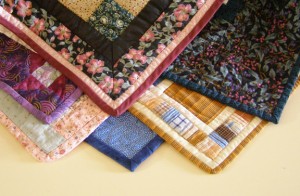
I found out the hard way with two quilts.
One of my earliest quilts was a king-size monster. I took a sampler class after making just two quilts, so this was my third quilt. I’ve always loves samplers, a theme I think you’ve seen in my quiltmaking, like the Quilters Palette quilt.
So I had made a baby quilt and a wallhanging, then decided to tackle a kingsize quilt for our bed.
yeah, i know… my fellow class mates called me a….a…an over-acheiver… : /
What was I thinking? I do not know, except that I figured I could do it. And, I guess I did!
The only thing is, this was still during the age of hand quilting. There wasn’t even a thought of doing anything different, unless it was tying the quilt, and there was no way I was going to simply tie this lovely baby. Tying is a five-letter word!!
Not after all of my hard work in piecing these blocks. (which I did in 4 weeks’ time)
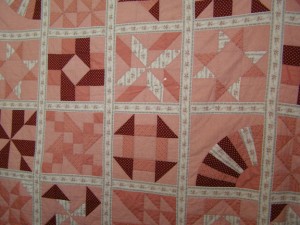 (I made this quilt when pink and gray were popular. I matched the colors — so the dark burgundy — to a print that we bought at a craft fair. Our bedroom was quite pretty, back in the day…)
So…. I quilted and quilted and quilted and quilted and quilted… Ok, so you get the picture. I thought this was never going to get done. I even called a hand quilter and asked her if she would finish it for me and she wanted to charge me $800 — in 1985!!!! I just about dropped the phone. For that price, I didn’t care if it took me five more years.
Actually, it did take me five more years to finish it. I put in my last stitch in 1990 while I was out on medical disability with full-blown influenza and was watching the epic mini-series, the unhappy, 
I had planned a nice big 12″ border with all of this great hand quilting in it and decided it was just too much. So what did I do?
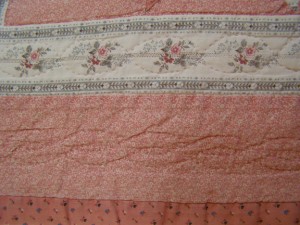 (the bottom print was going to be the 12″ border)
I simply cut the border and wrapped it around the back to become the BINDING. That, my quilting friends is a major NO-NO and my photos should show you why.
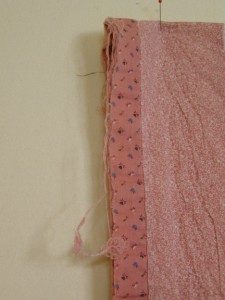 It even frays when it’s washed.
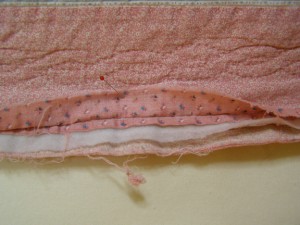 This what is exposed.
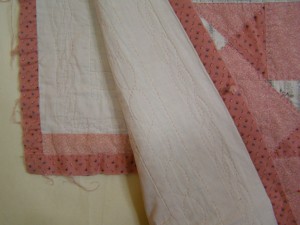 The back of the quilt — border fabric wrapped around and whip-stitched in place. All of that work to end up like this… and it’s that way around all four sides.
One thickness of fabric is not sufficient to encase the quilt. In fact, museums that have quilt collections discovered years ago that the part of the quilt that wears the most and has the most damage is the… Binding, of course!
I switched to bias bindings after that quilt because one of my quilting teachers said that bias binding is the most durable. But it was a hassle, trying to figure out how to create one continuous bias strip, like in this diagram:
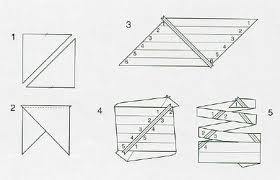
not to mention figuring how many YARDS of binding you need for a quilt! Oyoyoy.
Then, someone started teaching that you really don’t need bias binding, you need double fold binding and it can actually be cut from the straight of the grain! Cool! Ok, I can do that.
So I did. A lot.
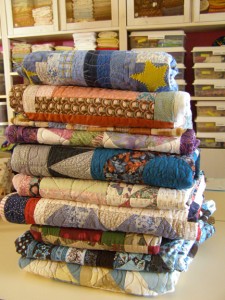
Until I discovered that THIS happens with bed quilts that touch men’s stubbly bed-time faces…
The fact is that straight of the grain binding is like single thickness binding, the top edge wears through to the second thickness like this:
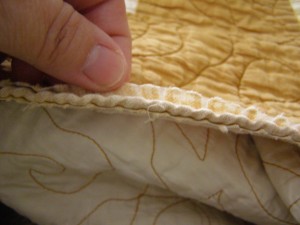
it got worn away by whiskers.
so, straight of grain binding isn’t as good as good old bias binding either. It still needs to be double fold binding for strength and smoothness.
I’ve acquiesced. Now I just cut bias strips and sew the ends together instead of worrying about creating that tube.
I think my quilts will be more durable over the next few decades and hopefully long after I’m gone.
So, what do YOU think? to win today’s Give-away, you need to tell me what you think about binding.
The prize…
What do Jelly Rolls and Binding have in common?
Well, Jelly Rolls are 2 1/2″ strips, right? Perfect double fold binding size! But — because they are cut on the straight on the grain, you can’t use the strips for binding, or I will come after you. (Just kidding!)
You can, however, use them to make some of the really fun quilts in this book:
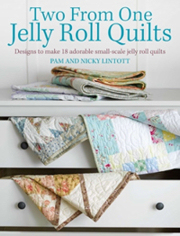
Why do I like this book? It has 18 fun and easy quilts that you can make, and, you can make two quilts from just one jelly roll! This is the perfect book for you if you have a stash of jelly rolls. The quilts are really fun — beginning from simple to advanced piecing techniques, so you have a nice assortment from which to choose.
A fun note about Pam and Nicky — they reside in the UK and own a shop called The Quilt Room. They live in Surrey and have 3 other books that all use Moda Bake Shop cuts for the patterns.
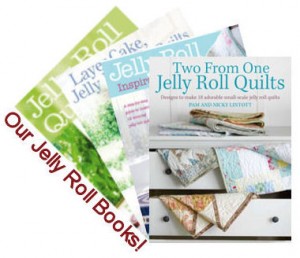
Here is a link to their blog. And they have a free patterm for a Jelly Roll quilt called Pom Pom Parade that you can download.
They look like fun gals that I’d like to meet. Hey, maybe at Quilt Market!!
One final picture that I caught when taking the picture of the blocks:
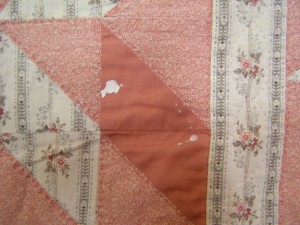 What in the HECK happened here?! It feels like Liquid Paper…
©2011 Annie Smith All Rights Reserved
Great topic, in that I was finishing the binding on my latest quilt today! I like the “double fold” method since getting Sue Nickel’s book “Machine Quilting” – it’s an excellent resource and also for the prefect corners! I sew onto right side with machine and to the back by hand (haven’t yet found the perfect machine method for that!). I like to wax my thread for strength and less tangles – and have also found that “twirling” the needle every so often between the fingers (usually counter clockwise) also helps reduce thread tangling! Lately seem to do a lot of “black” bindings – which are hard on the eyes for hand sewing! I’ve even done multi coloured bindings – they’re fun. Getting that binding on is always a great feeling of accomplishment!
Would love that Jelly Roll book as have a couple jelly rolls in my stash calling out to be made into something – thanks for the link to the Quilt Room blog – also great little free pattern!
I recognise some of those fabrics in your pink and grey quilt … I am still sleeping under one with those same fabrics!
I use double fold binding … and can say it lasts for twenty years, even in ‘his’ side of the bed, and figure that is a fair run, and after that amount of time I am happy to replace the binding.
Judy B
I have much more success with bias binding by just cutting bias strips and sewing them together. Works for me and the end result is the same as the continuous bias strip.
I try to go with 2 1/4″ bias binding on the quilts that will be used (lap, bed, etc) and for hangings and table runners, etc, I have very good results with straight grain single or double binding.
I’ve only been quilting since 2002. I only use bias binding that I make myself using the tube method.
http://sandyquilts.blogspot.com/2009/07/bias-binding-tutorial.html
AND I hand stitch it on to the back too.
I love love bias binding … it is THE BEST in my opinion.
I’ve been using double-fold straight grain binding (except on a tree skirt because it is octagonal). I haven’t had a problem, but I’ve only been quilting for a couple of years, so I think you have convinced me. I’ll do the bias binding next time (it wasn’t really much harder).
Hi Annie,
I actually enjoy doing the binding for a quilt. I learned the tube method from my quilting 101 class and have used it for all my quilts. My hand sewing on the back could use some improvement, though. Thanks for the giveaway. You are moving up on that episode 200!
Gayle
I use straight grain binding for wall hangings since they will see very little wear. I also admit to being too lazy to make bias binding most of the time, so resort to straight grain – I haven’t had to replace one yet, but I have enough quilts right now that there are plenty to rotate. I always make an exception if I have a striped fabric to use as the binding – I love the spiral effect from cutting stripes on the bias!
oh binding! My favorite topic! Honest. 🙂
But first .. your floral stripe? I have that! I made 12 placemats with that as the binding (not knowing any better and besides, this is what the instructor said to do) and it absolutely disintegrated along the foldline after many years of laundering.
Now, as to binding! 99% of the time, I use double fold bias binding. It’s the most durable binding you can put on a quilt. Theoretically, you have *two* layers of *crossed* threads on the fold line .. very durable. The problem with any straight of grain binding is that (theoretically), you have only *one* grainline thread on the fold .. very susceptible to falling apart, as you have found out.
I have discussed this topic much more thoroughly on my webpage at http://pir8.freeservers.com/quilting/CBT/index.htm …and on that page, I have a downloadable PDF which contains how much yardage to buy if you know how much bias you need (which you would because you know the perimeter of your quilt).
I also have a webpage that shows you how to make that very last seamline .. the one that joins the tails of the binding .. invisible; it’ll look like any other diagonal binding seam. That tutorial (and downloadable PDF) is at http://pir8.freeservers.com/quilting/ending-double-fold-binding/index.htm
You can *always* use bias binding on a quilt. There is never an inappropriate circumstance to not use it. Obviously, you *must* use bias binding if you are going around curves .. straight of grain binding simply won’t go around the curves nicely.
To sum up .. I love, love, love bias binding! Honest. 🙂
oh! another comment! You *can* use jelly rolls for bias binding! Honest!
Make a strip set with the jelly roll noodles so that you have, say, 18″ of “selvage” length. The strip set will be 40″ (or so) long.
You’ve just *made* your own “fabric”! Now, use this custom made fabric to make your own diagonally striped binding by making continuous bias from the strip set!
It turns out absolutely AWESOME! I’ve done this many times with different width strips (just to get a different diagonally striped effect), instead of always using a 2-1/2″ noodle. The resultant striped binding is simply too fantastic to be believed!
Great info here, Annie. For sure, bed quilts need a good, sturdy binding. But, for anything else, wallhangings, etc., anything goes!
I do have some jelly rolls on hand, but if I won this book, I would give it to my daughter who will be moving in a couple months to another state. I think she’ll need to start a new project so she doesn’t miss me so much! (or maybe I’ll need to start a new project so I don’t cry so much….)
I’ve used both methods of binding and have not had a major problem with either, but I guess time will tell. I do use silk thread when I’m hand sewing the binding to the back. It seems to run more smoothly and makes the job seem quicker.
Annie,
Yes, I am now converted to bias binding also!
It just does not pay otherwise! “Two From One Jelly Roll Quilts” sounds like a fun book! Put me in the bowl!
Emily
I’ve really enjoyed all the subjects you’ve talked about. Loved the mission and Hitchcock, too. Your granddaughter is SO cute! About binding: I always use bias binding on any quilt larger than miniature. I like a narrow binding around my quilts, so I usually start with a single fold, 1 1/4 to 1 1/2 inch bias strip. I also sew my strips together instead of making a tube–that always made me crazy! I now start sewing my binding at the upper left hand side of the quilt so that any imperfections won’t show as much–tip from Libby Lehman. I may have used a double fold binding on a grandchild’s quilt, but I just don’t remember–the binding on their quilts still looks good even with all the use.
Judy McNeel
how about prairie points? I do alot of prairie points on my quilts and wondered if you had any information on wear for that type of finishing.
I have used double and the straight and the bias and have not had the same wear…if fact I just got a quilt back from my mother that was well loved and it was the sun that damaged the top more than anything and yes you are right whiskers of men are a culprit as well…LOL
I have not tried using bias binding yet, but you have definitely given me inspiration!
I am so new to quilting that I have yet to finish any project. Thank you for the binding advice. The pictures are etched in my memory and I will not take the same paths that you did, Annie.
I know, I know, I should use bias binding. I hate bias binding. OK you got me. I should use bias binding.
Hi Annie
Noah and I were just choosing binding fabric and the woman at the quilt store asked why we would bother with a bias binding. Noah explained the wearing problem with straight grain binding very eloquently. He is nearly finished his Exploring Fabric Choices quilt.
This is a great post, I think the whole point is that when you go to the time and expense to make a quilt, take whatever extra time to make it right. I love bias binding, and I also always sew it on with my walking foot. It goes along with using nice quality fabrics, threads, and batting. If I am making a big quilt, I sometimes pull out that confusing diagram and make continuous bias binding, but more often, I just cut the strips across the bias of the fabric. p.s…. you can’t fold your fabric while cutting the strips, or you end up with pieces that look like a big “V”. ha ha.
I have mostly used straight edge binding and have enjoyed success with it. My kids beat my quilts to death and still no problems. I have refined my skills on adding the binding over the years. I used to be haphazard when sewing on the bindings and on a couple of quilts the edge kinda fell off in places. LOL
Annie, My goodness….there is something new to learn everyday in the world of quilting! I have never used bias binding. I had no idea that straight grain binding could wear away like you showed. Thanks for the info!
-debby
Chester, NY
Hmmmm….I know but….my problem isn’t bias binding so much as it is mitred corners. I have trouble visualizing them — similar to my trouble with paper piecing. I ‘transpose’ things like this (see them upside down or backwards) and it takes me *hours* just to do one corner. Any suggestions?